− 60 m · Sunlit zone
Light still reaches here. Cargo ships drag their weight across the surface above; the low hum carries down through the water column for hundreds of kilometers.
It is the same band a whale would call in. A container ship leaving Long Beach and a blue whale calling off the coast will both be heard in Hawaii by tomorrow morning. They will arrive at almost the same time.
Below this layer, the color leaves first.
− 200 m · Twilight
. . Their songs are slow and low. In cold water they carry for hundreds of kilometers, and sometimes farther.
Whales sing to find each other.
− 400 m · Midnight begins
In 1989, analysts monitoring a US Navy listening array notice something on the tape. It has the shape of a baleen whale call. It has the rhythm of one. It is pitched far higher than any whale on record. Sharper. Faster.
The signal centers near 52 Hz.
Blue whales call near 15. There is a roughly two-octave gap between this animal and every other one of its kind in the ocean.
The note is logged. Strange sounds are routine here. The call is not heard again that season.
− 600 m · Pressure builds
The next season, the same call returns. Same frequency. Same rhythm. From a single source, somewhere near 46° north, 126° west.
The season after that, again. And again.
From 1992 onward, Navy and Woods Hole analysts begin tracking it in earnest. Twelve consecutive seasons. Always one source. Never overlapping with itself.
− 780 m · Approaching the array
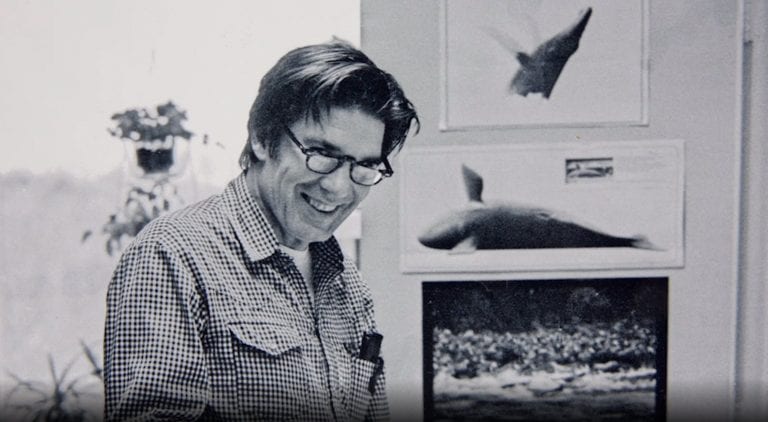
In 2004, William Watkins, Mary Ann Daher and their colleagues at Woods Hole publish their findings: twelve years of tracks across the central and eastern North Pacific, from the Gulf of Alaska down to the latitude of Baja California.
The routes match no known whale. The animal does not travel with blue whale pods. It does not travel with fin whales. Its calls never overlap with another of its kind, because there is no other of its kind in any of the recordings.

− 914 m · The hydrophone
Here. SOSUS, the Sound Surveillance System, strung across the deep Pacific by the US Navy in the late 1950s to listen for Soviet submarines. Partially declassified for biology in 1992. Through it, for the first time, scientists could hear what the ocean had been saying all along.
It records everything: the , the , the that, on the spectrogram, looks like television static.
And, every season from August through January, the .
The crowded band below is the conversation of every other whale in the Pacific. The single line above it is the one we cannot place. Three to ten seconds long. Repeated in groups of two to twenty, in series that can last hours.
The theories
Some scientists suggest a hybrid, a blue and fin mix that fits nowhere. Others propose a vocal structure slightly off, lifting the song just above the range other whales can hear. A few argue for deafness: a whale calling out without knowing what calling out is supposed to sound like.
One cryptozoologist offers a different idea entirely.
The last survivor of an unidentified species, plying the oceans in a doomed search for another of its kind.
— a theory, offered without evidence
It is the word science uses when it has no category.
What is known
The whale, by every measure available, is alive and persistent. Its calls are loud and well-defined. They are recorded from August into early February, with most of the calling clustered in December and January. From February to August, the array waits.
It travels between 31 and 69 kilometers a day, averaging 47. In a single season, 2002–2003, it covered 11,062 kilometers across 176 days. From northern waters near 52° north, it traveled all the way down to 33° north, off Baja California. The longest individual whale track in the research record.
Twelve years of data. One animal. No answer on the recording but its own.
The letters
When the story reaches the press, something shifts. Letters arrive at Woods Hole. Then emails. Thousands of them.
People write to say they understand what the experience feels like. They mean producing a clear signal, in the correct form, at the correct time, only to hear nothing back.
Click any letter to read it. They keep arriving.
What the call became
The letters were the first thing. After the letters, people made other things.
A foundation. A song. A children's novel about a deaf girl who decides to find a whale that sings at a frequency no other whale can hear. An essay. A documentary that Leonardo DiCaprio helped produce. Tattoos on forearms in cities the whale will never swim past.
None of it was planned. People read about the whale and made something so they would not forget.
Each bubble is a real artifact. Click to open.
And now, you
You have read the letters. You have seen what people did with the story.
Now you can use the array yourself.
Send your own call into the dark
Press the button and the array will broadcast at 52 hertz.
The search
In 2015, the filmmaker Joshua Zeman charters a research vessel and spends weeks off the California coast dropping hydrophones, hoping to put eyes on the animal. They pick up the call. Fifty-two hertz, exactly where it should be.
They never see the whale.
One thing the recordings have confirmed: the call has slipped about two hertz lower over the years it has been monitored.
The whale is still moving. It is still calling. It has outlasted the Cold War infrastructure that first recorded it, every projection about what a whale is supposed to sound like, and one of the two scientists who first understood it.
William Watkins died in 2004. His paper was published the same year.


In 2010, sensors in different parts of the Pacific picked up 52-hertz calls at the same time, from places too far apart to be the same whale.
They have never met. There may be two of them now, somewhere in the same ocean.
data · Watkins et al., Woods Hole · UCSB Geography
a tribute to the 52-hertz whale